
Physiotherapist help people with physical difficulties resulting from illness, injury, disability or aging to improve their movement. You will devise and review treatment programmes using manual therapy (such as massage), therapeutic exercise and electrotherapy.
Physiotherapists usually recommend movement and exercise to help improve your mobility and function. … exercises carried out in warm, shallow water (hydrotherapy or aquatic therapy) – the water can help relax and support the muscles and joints while providing resistance to help you gradually strengthen.
So as a physiotherapist sharing awesome educational and inspiring content to your followers will help you get the message of how effective physiotherapy treatments can be within your community.
And with this Physiotherapy Facts Bundle, you’ll be able to do just that.
All 20 visual facts are just as amazing as the human body, filled with Scientific facts, mind-awakening truths, history and what every person on social media should know.
That you can go physical, emotional, and mental. Now, you can even succeed in social.
Get Engagement Moving. Be the talk of Physiotherapy town and beyond when you present this Physiotherapy Facts Bundle on Social media. No other physiotherapy facts have been this moving, captivating, exciting and engaging, in terms of presentation, concept, and design.
It’s meant to get people to move on social media and move towards you.
Bye Big Fat Lies. People deserve to know whom they can turn to if other experts can’t find the root of their health problems. With this Physiotherapy Facts Bundle, you’ll break down the barrier on social media that’s stopping the population from embracing physiotherapy. You’ll be surprised that it can actually be easy to engage, even fun.
Exercise is now Easy. People really do want to exercise, but many can’t. That’s the same with social media. If you can help your patients find a way to get active and moving, this Physiotherapy Facts Bundle can do the same for you on social media. It makes high-quality content look easy.
Simplify and Save Time – The best part is that you don’t even need to put the time into creating the content to post on social media yourself.
Download this bundle now, add your logo to brand them as your own and share them on your social media pages.
Inside The Bundle
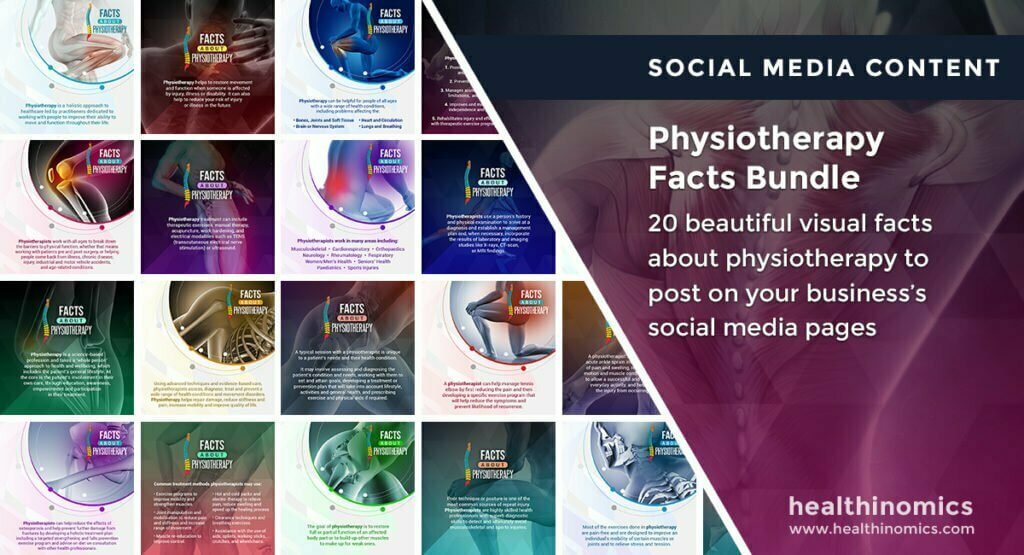
The Physiotherapy Facts Bundle includes 20 beautiful images:

Image Content
- Physiotherapy is a holistic approach to healthcare led by practitioners dedicated to working with people to improve their ability to move and function throughout their life.
- Physiotherapy helps to restore movement and function when someone is affected by injury, illness or disability. It can also help to reduce your risk of injury or illness in the future.
- Physiotherapy can be helpful for people of all ages with a wide range of health conditions, including problems affecting the:
- Bones, Joints and Soft Tissue
- Brain or Nervous System
- Heart and Circulation
- Lungs and Breathing
- Physiotherapy can benefit you in many ways:
- Promotes optimal mobility, physical ability, and overall health and wellness.
- Prevents disease, injury and disability.
- Manages acute and chronic conditions, activity limitations, and participation restrictions.
- Improves and maintains optimal functional independence and physical performance.
- Rehabilitates injury and effects of a disease or disability with therapeutic exercise programs and other interventions.
- Physiotherapists work with all ages to break down the barriers to physical function, whether that means working with patients pre and post surgery, or helping people come back from illness, chronic disease, injury, industrial and motor vehicle accidents, and age-related conditions.
- Physiotherapy treatment can include therapeutic exercises, manual therapy, acupuncture, work hardening, and electrical modalities such as TENS (transcutaneous electrical nerve stimulation) or ultrasound.
- Physiotherapists work in many areas including:
- Musculoskeletal
- Cardiorespiratory
- Orthopaedics Neurology
- Rheumatology
- Respiratory Women/Men’s Health
- Seniors’ Health Paediatrics
- Sports Injuries
- Physiotherapists use a person’s history and physical examination to arrive at a diagnosis and establish a management plan and, when necessary, incorporate the results of laboratory and imaging studies like X-rays, CT-scan, or MRI findings.
- It is widely believed that Physiotherapy techniques were used as far back as 460BC, when early physicians such as Hippocrates practiced elements of Physiotherapy like manual therapy and massage.
- Physiotherapy is a science-based profession and takes a ‘whole person’ approach to health and wellbeing, which includes the patient’s general lifestyle. At the core is the patient’s involvement in their own care, through education, awareness, empowerment and participation in their treatment.
- Using advanced techniques and evidence-based care, physiotherapists assess, diagnose, treat and prevent a wide range of health conditions and movement disorders. Physiotherapy helps repair damage, reduce stiffness and pain, increase mobility and improve quality of life.
- A typical session with a physiotherapist is unique to a patient’s needs and their health condition. It may involve assessing and diagnosing the patient’s condition and needs, working with them to set and attain goals, developing a treatment or prevention plan that will take into account lifestyle, activities and general health, and prescribing exercise and physical aids if required.
- A physiotherapist can help manage tennis elbow by first reducing the pain and then developing a specific exercise program that will help reduce the symptoms and prevent likelihood of recurrence.
- A physiotherapist’s management of an acute ankle sprain involves the reduction of pain and swelling, restoration of ankle motion and muscle conditioning, exercises to allow a successful and timely return to everyday activity, and help to prevent the injury from occurring again.
- Physiotherapists can help reduce the effects of osteoporosis and help prevent further damage from fractures by developing a holistic treatment plan including a targeted strengthening and falls prevention exercise program and advice on diet on consultation with other health professionals.
- Common treatment methods physiotherapists may use:
- Exercise programs to improve mobility and strengthen muscles.
- Joint manipulation and mobilisation to reduce pain and stiffness and increase range of movement.
- Muscle re-education to improve control.
- Hot and cold packs and electro-therapy to relieve pain, reduce swelling and speed up the healing process.
- Clearance techniques and breathing exercises.
- Assistance with the use of aids, splints, walking sticks, crutches, and wheelchairs.
- The goal of physiotherapy is to restore full or partial function of an affected body part or to build up other muscles to make up for weak ones.
- Poor technique or posture is one of the most common sources of repeat injury. Physiotherapists are highly skilled health professionals with superb diagnostic skills to detect and ultimately avoid musculoskeletal and sports injuries.
- Most of the exercises done in physiotherapy are pain-free and are designed to improve an individual’s mobility of certain muscles or joints and to relieve stress and tension.
- Physiotherapists are trained in the use of exercise therapy to strengthen your muscles and improve your function. Physiotherapy exercises have been scientifically proven to be one of the most effective ways that you can solve or prevent pain and injury.
- Includes 20 Images
- Image Sizes: 900 x 900 px
- All images are high resolution PNG
- Add your own branding!
Share this:
- Includes 20 Images
- Image Sizes: 900 x 900 px
- All images are high resolution PNG
- Add your own branding!