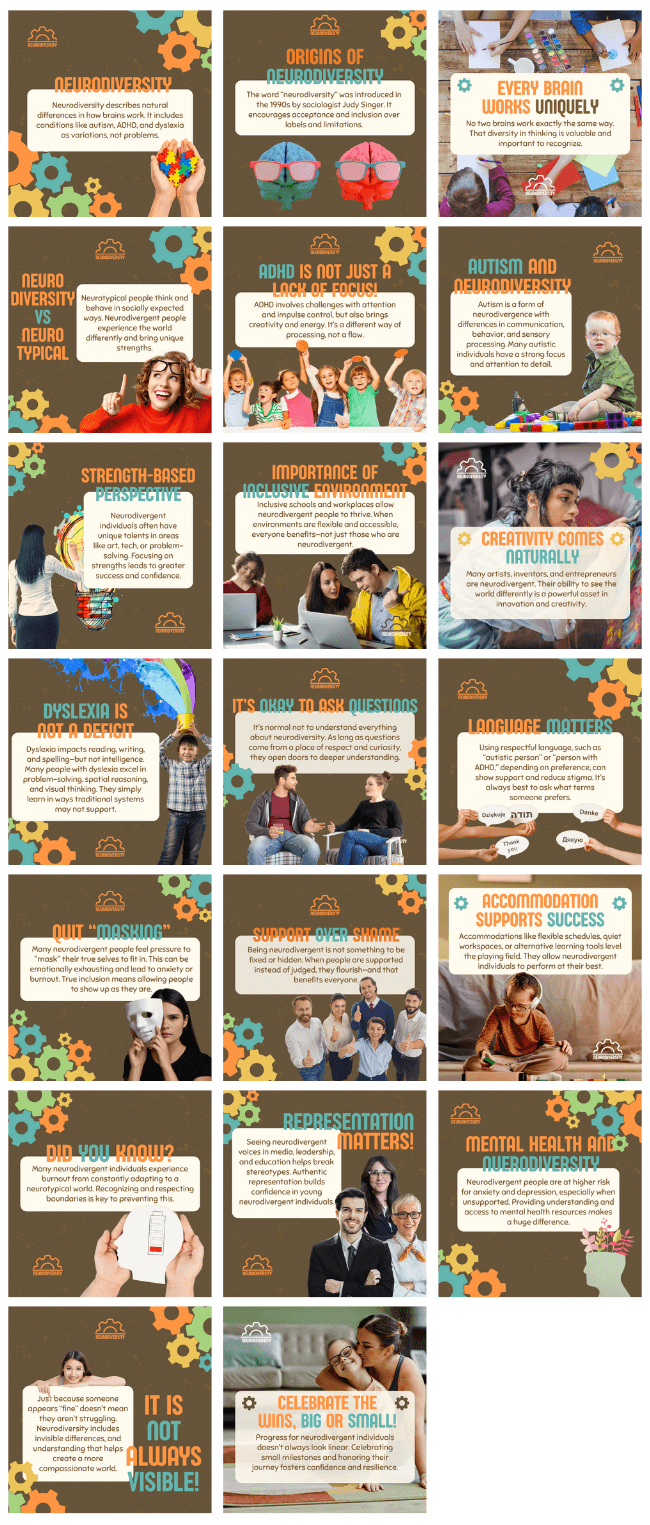
Neurodiversity is the concept that neurological differences—such as autism, ADHD, dyslexia, and others—are natural variations of the human brain, not deficits or disorders to be “fixed.” Sharing neurodiversity social media images can play a powerful role in shifting public perception, promoting acceptance, and encouraging inclusive behaviors. These educational posts can help dismantle harmful stereotypes and foster empathy by highlighting strengths, not just challenges. This not only supports neurodivergent individuals but also educates neurotypical followers, cultivating a more understanding and compassionate online community. Over time, it can inspire schools, workplaces, and even families to adopt more inclusive practices and celebrate the richness that neurodiverse minds bring to the world.
1. NEURODIVERSITY
Neurodiversity describes natural differences in how brains work. It includes conditions like autism, ADHD, and dyslexia as variations, not problems.
2. ORIGINS OF NEURODIVERSITY
The word “neurodiversity” was introduced in the 1990s by sociologist Judy Singer. It encourages acceptance and inclusion over labels and limitations.
3. EVERY BRAIN WORKS UNIQUELY
No two brains work exactly the same way. That diversity in thinking is valuable and important to recognize.
4. NEURODIVERSITY VS. NEUROTYPICAL
Neurotypical people think and behave in socially expected ways. Neurodivergent people experience the world differently and bring unique strengths.
5. ADHD IS NOT JUST A LACK OF FOCUS!
ADHD involves challenges with attention and impulse control, but also brings creativity and energy. It’s a different way of processing, not a flaw.
6. AUTISM AND NEURODIVERSITY
Autism is a form of neurodivergence with differences in communication, behavior, and sensory processing. Many autistic individuals have a strong focus and attention to detail.
7. STRENGTH-BASED PERSPECTIVE
Neurodivergent individuals often have unique talents in areas like art, tech, or problem-solving. Focusing on strengths leads to greater success and confidence.
8. IMPORTANCE OF INCLUSIVE ENVIRONMENT
Neurodivergent individuals often have unique talents in areas like art, tech, or problem-solving. Focusing on strengths leads to greater success and confidence.
9. CREATIVITY COMES NATURALLY
Many artists, inventors, and entrepreneurs are neurodivergent. Their ability to see the world differently is a powerful asset in innovation and creativity.
10. DYSLEXIA IS NOT A DEFICIT
Dyslexia impacts reading, writing, and spelling—but not intelligence. Many people with dyslexia excel in problem-solving, spatial reasoning, and visual thinking. They simply learn in ways that traditional systems may not support.
11. IT’S OKAY TO ASK QUESTIONS
It’s normal not to understand everything about neurodiversity. As long as questions come from a place of respect and curiosity, they open doors to deeper understanding.
12. ACCOMMODATION SUPPORTS SUCCESS
Accommodations like flexible schedules, quiet workspaces, or alternative learning tools level the playing field. They allow neurodivergent individuals to perform at their best.
13. LANGUAGE MATTERS
Using respectful language, such as “autistic person” or “person with ADHD,” depending on preference, can show support and reduce stigma. It’s always best to ask what terms someone prefers.
14. QUIT “MASKING”
Many neurodivergent people feel pressure to “mask” their true selves to fit in. This can be emotionally exhausting and lead to anxiety or burnout. True inclusion means allowing people to show up as they are.
15. SUPPORT OVER SHAME
Being neurodivergent is not something to be fixed or hidden. When people are supported instead of judged, they flourish—and that benefits everyone.
16. DID YOU KNOW?
Many neurodivergent individuals experience burnout from constantly adapting to a neurotypical world. Recognizing and respecting boundaries is key to preventing this.
17. REPRESENTATION MATTERS!
Seeing neurodivergent voices in media, leadership, and education helps break stereotypes. Authentic representation builds confidence in young neurodivergent individuals.
18. CELEBRATE THE WINS, BIG OR SMALL!
Progress for neurodivergent individuals doesn’t always look linear. Celebrating small milestones and honoring their journey fosters confidence and resilience.
19. MENTAL HEALTH AND NEURODIVERSITY
Neurodivergent people are at higher risk for anxiety and depression, especially when unsupported. Providing understanding and access to mental health resources makes a huge difference.
20. IT IS NOT ALWAYS VISIBLE!
Just because someone appears “fine” doesn’t mean they aren’t struggling. Neurodiversity includes invisible differences, and understanding that helps create a more compassionate world.